ByJohn A
Are Antimicrobial Curtains Worth the Extra Cost?
Price is a major factor when purchasing curtains in healthcare facilities. But looking at the initial cost alone isn’t always enough.
Antimicrobial curtains can cost more than regular curtains. That’s why a practical question arises: Is the extra price worth it?
The answer won’t be the same for every facility. The decision is best made by looking at room usage, cleaning process, replacement needs, and overall maintenance.
What Does Antimicrobial Mean?
Antimicrobial curtains can be manufactured with a treatment or material that helps reduce the growth of microorganisms.
But that doesn’t mean the curtain completely eliminates germs. Nor is it a replacement for regular cleaning. It’s more accurate to think of this feature as an additional consideration in a healthcare environment.
Why Are Antimicrobial Curtains Considered?
Hospital curtains can be frequently touched surfaces. Patients, nurses, and visitors may move them daily. For this reason, curtain material should not be selected based on appearance alone.
If a facility has high curtain usage, antimicrobial features can be a useful consideration. But it is also important to look at the cleaning and replacement process.
Is the Extra Price Worth It?
Is the extra price worth it? This depends on the actual needs of the facility.
If the curtain is installed in a high-use area and the facility wants to manage hygiene requirements more closely, then an antimicrobial option may be considered.
However, if the curtain is in a less-used area, a standard washable or disposable option may be more practical. Therefore, a decision should not be made based solely on the higher price.
Look Beyond the Purchase Price
The actual cost of a curtain is not just the amount paid at the time of purchase. Maintenance, cleaning, laundry, staff time and replacement also form part of the total cost. When comparing curtains, it is best to look at how they will affect the long-term workflow. Sometimes a slightly more expensive option can be more practical in terms of maintenance.
What About Healthcare Privacy Curtains?
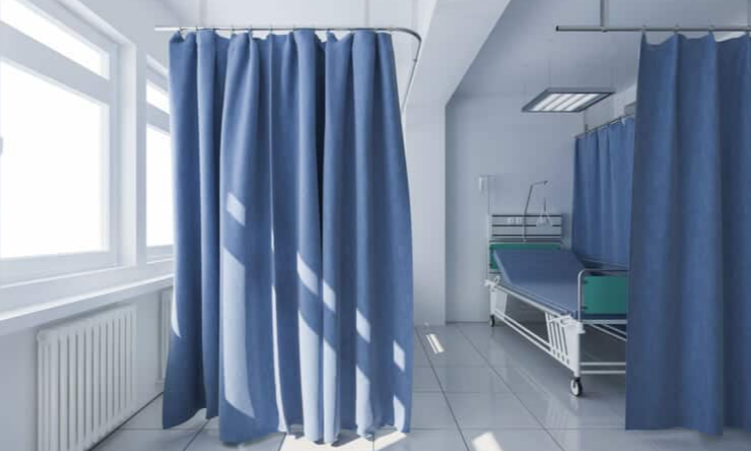
The primary function of Healthcare Privacy Curtains is to provide visual privacy to the patient. Antimicrobial treatment can be an additional feature in addition to this primary purpose.
The facility should also consider whether the curtain can be easily removed. It is also useful to consider cleaning and future replacement in advance.
It is not appropriate to automatically assume that a curtain is better just because of the antimicrobial label.
Does the Track Affect Overall Value?
Yes. The performance of a curtain does not depend solely on the fabric. Healthcare Curtain Track plays a key role in the movement, coverage, and removal of the curtain.
If the track is difficult to operate, curtain changeout can take up more staff time. Therefore, the track system should be evaluated along with the curtain.
Why Does Cubicle Curtain Track Matter?
Cubicle curtain track should be tailored to the shape of the room and the required privacy coverage. Straight, curved, and different configurations can be useful for different room layouts.
When selecting a track, also consider the mounting surface, curtain size, and movement. A suitable track can also make future replacement easier.
What Is a Privacy Curtain Track System?
Privacy curtain track system is not just for hanging curtains. It includes the track configuration, attachment method, and curtain movement.
If the system is easy to operate, curtain removal and replacement can be more manageable for staff.
That’s why it’s a more sensible approach to look at the complete system when choosing an antimicrobial curtain.
Are Disposable Cubicle Curtains a Better Option?
Disposable Cubicle Curtains may be an alternative antimicrobial option for some facilities. In areas where frequent changeout is important, disposable curtains can reduce laundry requirements.
But disposal, purchasing frequency, and overall cost should also be considered. The decision between reusable and disposable options may vary for each facility.
What Should You Compare?
If there is a price difference between two curtain options, don’t just compare the material.
Also consider these points:
- Cleaning requirements
- Expected usage
- Replacement frequency
- Staff handling
- Track compatibility
- Disposal or laundering process
This comparison can provide a more realistic picture.
When Is the Extra Cost More Justifiable?
An antimicrobial option may be particularly relevant in areas where curtains are frequently touched. It is also important to regularly monitor curtain condition in high-use patient areas.
If a facility already maintains a strong cleaning and replacement program, an antimicrobial feature can be an additional layer to that system.
But if basic maintenance is not being properly managed, simply purchasing an antimicrobial curtain will not be a complete solution.
When Might a Standard Curtain Be Enough?
Not every room needs a premium feature. In low-use areas, a standard healthcare curtain can meet a facility’s privacy requirements.
If the curtain is being cleaned, inspected, and replaced regularly, the facility should make decisions based on its actual needs. Budgets also need to be balanced with the overall maintenance plan.
How Does the Track Help With Long-Term Maintenance?
Easy curtain removal can simplify the maintenance process. If staff can remove the curtain quickly, the chances of delaying cleaning or replacement can be reduced.
On The Right Track Hospital Curtain Track solutions can be evaluated by looking at the facility’s room layout, curtain requirements, and future changeout needs. This approach focuses on the complete system value rather than just the curtain purchase.
Choosing the Right System
A good healthcare curtain system doesn’t depend on just one feature. Material, privacy, track design, cleaning and replacement are all connected.
On The Right Track Privacy Curtain System can also be evaluated according to these same practical requirements. A facility should first identify its needs. Then it becomes easier to compare available options.
Final Answer
So, Is the extra price worth it? Sometimes yes, and never no. Antimicrobial curtains can be a useful additional feature in high-use healthcare spaces. But their value is more meaningful when the facility is also properly managing cleaning, inspection and replacement.
If the budget is limited, first compare room usage, maintenance requirements and long-term costs. Ultimately, the best choice is one that doesn’t just offer more features but also truly fits the facility’s daily workflow, privacy needs and maintenance plan.